Why Daily Team Huddles Might Be Killing Your Growth (And What to Do Instead)
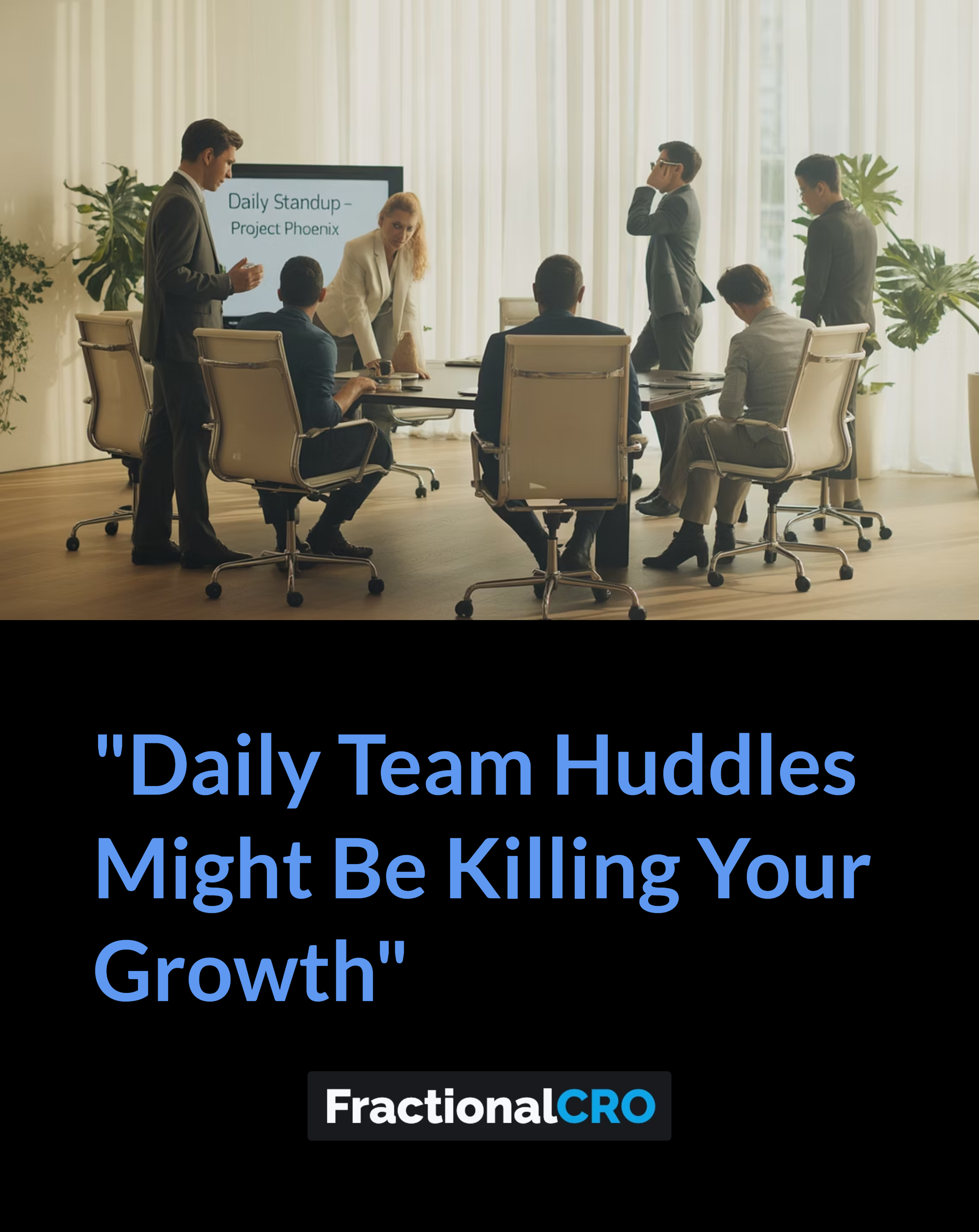
“We’re aligned.” “We’re all on the same page.” “This is our moment of connection.”
Sound familiar?
Daily huddles have become the sacred cow of modern business culture. Popularised by books like Scaling Up and Traction, they’re touted as a non-negotiable ritual for high-performing teams.
But here’s the problem: most team huddles are an illusion of productivity.
And if you’re trying to scale, that illusion can become dangerously expensive.
The Hidden Cost of the Daily Huddle
Let’s say you have a team of 10 people. You hold a 15-minute huddle every morning.
- That’s 2.5 hours of collective time per day
- Over 500 hours per year
- At an average salary of £50/hr, you’re looking at £25,000/year in time cost
Now ask: Is this huddle delivering £25,000+ in productivity, clarity, or revenue-driving outcomes?
In my experience as a Fractional CRO and Growth Consultant, the answer is often a hard no.
Here’s why.
Three Reasons Team Huddles Can Be Counterproductive
1. They Reward Noise, Not Outcomes
Most huddles turn into status updates, not decision-making forums. People talk to be seen, not to solve. Momentum gets mistaken for motion.
2. They Kill Deep Work
Pulling your team into daily syncs at 9am disrupts focus cycles. Just as someone’s getting into a flow state—boom, it’s huddle time.
3. They Promote Dependency, Not Autonomy
Daily check-ins train your team to look for permission instead of making decisions. If every answer lives in the next huddle, you’ve slowed down your org.
What a Productive Huddle Should Actually Look Like
Don’t get me wrong. Alignment is crucial. But the format needs to evolve if you’re serious about scaling.
Here’s what a high-ROI huddle includes:
1. Metrics, Not Monologues
Each person shares one number that matters. No storytelling. Just signal.
“Pipeline coverage: 3.2x. On track.”
“Churn risk: 4 clients. Mitigation plan submitted.”
2. Blocker-Driven Agenda
Don’t rehash the plan. Surface obstacles. Fast.
“We’re stuck on legal approval—need CRO decision today.”
“Waiting on product specs—client can’t sign.”
3. 10 Minutes or Less
If it goes over 10, you’ve lost focus. Park deeper topics in a follow-up, not in the huddle.
4. Rotate Ownership
Don’t let the same manager run every session. Rotate facilitators. It builds leadership muscles.
5. Optional for High Performers
Trust your A-players. Give them permission to skip when they’re deep in revenue-generating work. That’s leadership, not absenteeism.
Rethink Rituals to Scale Smarter
Scaling a business means building systems that multiply time and output—not just fill calendars.
So next time someone says “Let’s huddle,” ask:
“Are we aligning—or just assembling?”
Because real alignment happens when your team is empowered to move fast, solve problems, and own outcomes—not just attend another standing meeting.
Want help designing a growth rhythm that works for your team instead of against them?
Let’s talk. I specialise in simplifying growth systems for scale.